

Working remotely for companies in the United States can open a new professional perspective: international experience, daily contact with English, and direct participation in the routine of businesses that need service, sales, and operational organization.
Building a career as a virtual assistant goes far beyond answering messages or organizing an agenda. Companies look for professionals capable of understanding processes, communicating clearly, taking responsibility and maintaining an important part of the operation functioning with consistency.
It is also important to align expectations. Remote work does not mean absence of schedule, low responsibility or freedom to perform activities whenever you want. In many operations, the assistant represents the company during business hours and needs to be available to serve customers, track leads and resolve demands in real time.
It is possible to start from scratch in acting as a VA without starting from scratch professionally. Previous experiences in service, sales, administrative routines, and customer relationships can form a valuable foundation for this transition.
What does a bilingual virtual assistant do?
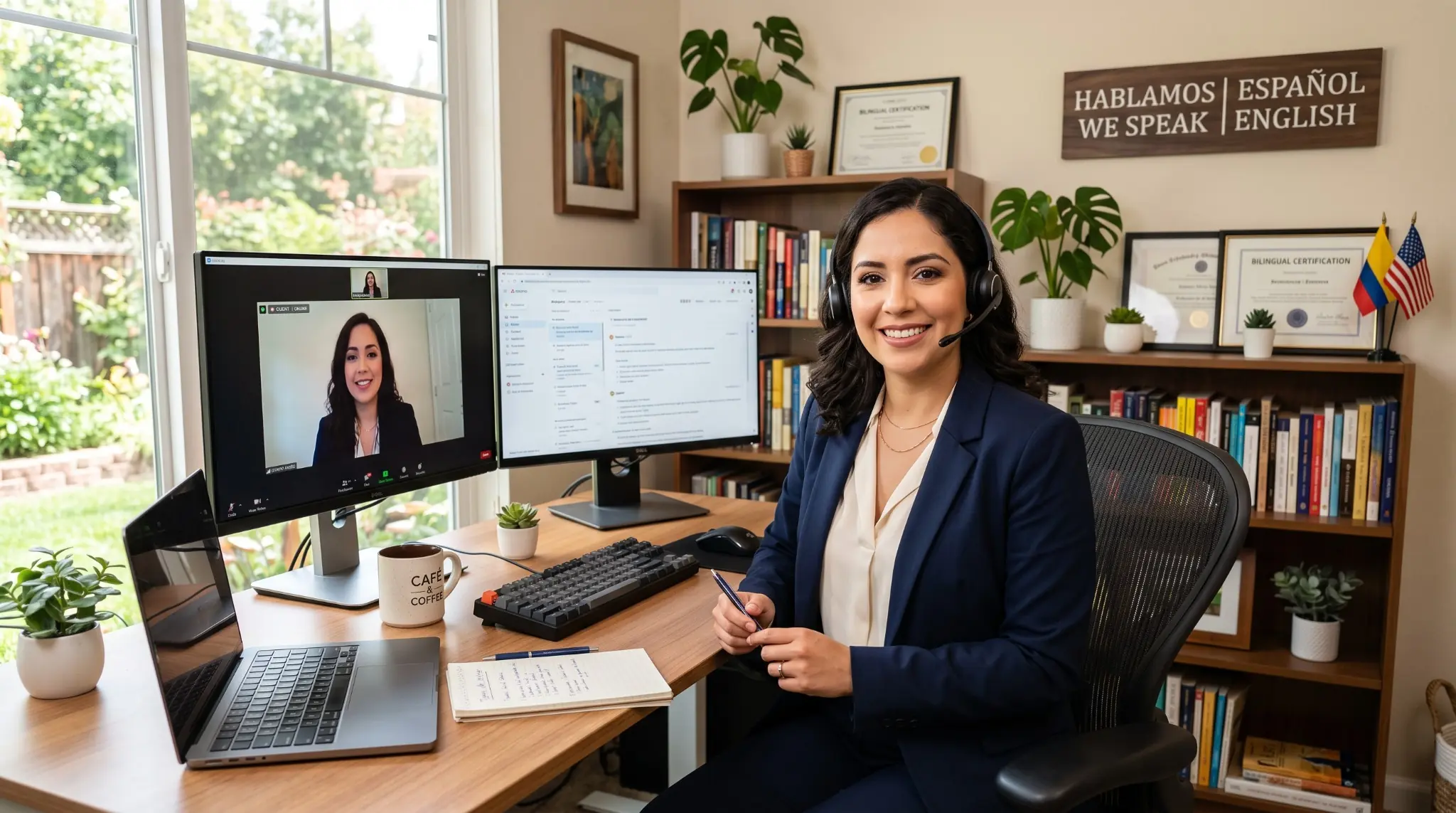
A bilingual virtual assistant is a professional who provides services remotely and uses two languages to support commercial, administrative and operational activities.
In Brazilian companies operating in the United States, this professional connects two parts of the operation: it communicates in English with customers, leads and suppliers, while maintaining alignment in Portuguese with owners, managers and other team members.
What does a bilingual virtual assistant do?
- Handling calls, messages, emails and forms
- Qualifying and following up with leads
- Organizing schedules and service confirmations
- Updating the CRM and customer history
- Sending information and following up on estimates
- Supporting billing and administrative routines
- Communicating among customers, management and field teams
- Tracking checklists and internal processes
The goal is not merely to complete tasks. It is to help customer service and operations maintain continuity, organization and consistent standards.
What do you need to get started?
There is no single compulsory training to act as a virtual assistant. People from different areas can adapt well to the role, provided they have competences compatible with the responsibilities assumed.
What do you need to get started?
- Advanced or fluent English
- Experience in customer service, sales or administrative routines
- Clear, professional communication
- Organization and responsibility with schedules
- Ability to learn systems and processes
- Computer, stable internet and an appropriate workspace
- Availability compatible with the company’s business hours
- Formal structure to provide services, such as an active MEI registration or willingness to open one
The title of “virtual assistant” may be new to you. , however, the necessary skills may already be part of their trajectory.
Step by step: how to become a bilingual virtual assistant
1. Recognize your transferable experiences
Step by step: how to become a bilingual virtual assistant
Experiences in reception, customer support, sales, commerce, hospitality, administrative area, billing, scheduling or relationship with the public can be applied to the routine of a VA.
Instead of presenting just one to-do list, learn to explain the results you helped produce. For example:
- Served clients and forwarded each request correctly
- Organized agendas and avoided schedule conflicts
- Followed sales opportunities until the client’s decision
- Kept up-to-date information and documents
- Solved problems within the company’s guidelines
This reading demonstrates professional maturity and helps the recruiter understand how their experience can be applied to a remote operation.
2. Develop professional English

To serve companies in the United States, knowing English casually is not enough. The professional needs to understand different ways of speaking, conducting calls, recording information correctly and maintaining communication even when the client is dissatisfied, in a hurry or asking unexpected questions.
No need to have a specific accent. The most important thing is to be able to listen, understand and respond with clarity, security and naturalness.
Practice real customer service situations, such as:
- Request name, address and telephone number
- Confirm dates and times
- Explain the next steps in the service process
- Conduct follow-ups
- Clarify company policies
- Deal with objections and complaints
- Transfer a situation to the appropriate person responsible
3. Understand how a service company works
A good virtual assistant does not simply read an incoming message. They understand what needs to happen next.
In a service business, a new contact may move through the following flow:
New lead → first response → qualification → CRM registration → estimate or visit → follow-up → scheduling → confirmation → post-service follow-up.
Knowing this path helps the professional understand the purpose of each task and identify the next step without relying on a new instruction at all times.
4. Learn how to use tools within processes
Google Calendar, spreadsheets, forms, communication platforms, service management systems, management tools, and CRMs can be part of the routine.
You don’t have to master all systems before you start. You need to demonstrate ease of learning and understanding why each tool is used.
CRM, for example, doesn’t just serve to store names. It records customer history, shows the stage of an opportunity, and allows someone else to continue service without losing context.
More important than decorating buttons is understanding the function of the tool within the company.
5. Learn to follow processes
Autonomy does not mean acting on personal preferences. It means knowing how to carry out an activity within established procedures.
A clear process defines:
- What information should be collected
- Where they must be registered
- What answers can be provided
- When making a new contact
- Which decisions require authorization
- When a situation needs to be directed to leadership
What sets a well-prepared professional apart?
6. Strengthen your professional communication
When serving a customer, the virtual assistant represents the company. Each message, connection and update influences the perception about the business.
Good professional communication requires:
- Clear and unambiguous writing
- Attention to the information received
- Objective questions
- Compatible with each situation
- Agility without hasty answers
- Record of the important points
- Balance when dealing with conflict
Being nice is important, but it's not enough. The customer also needs to understand organization, information mastery and security.
7. Prepare a suitable structure for remote work
Acting remotely requires an environment that allows you to provide quality service. The minimum structure includes reliable computer, stable internet, adequate headset and a quiet space to make calls.
It is also necessary to organize the routine itself. During the agreed period, the professional needs to follow the channels of service, meet deadlines and remain available for the demands of the operation.
The environment is remote, but the posture remains professional.
8. Prepare a presentation consistent with the opportunity
Curriculum and presentation video are important because they show different aspects of the professional profile.
The résumé should highlight experience related to customer service, sales, administration, languages, tools and previous responsibilities. The video helps the team evaluate communication, English proficiency, professional presence and the ability to explain an idea naturally.
In a professional video:
- Present yourself objectively
- Explain how you developed English
- Mention your training and relevant experiences
- Show how you can contribute to the company
- Avoid reading, excessive cuts and decorated responses
The company is not looking for a theatrical performance. It needs to see how you would communicate with a real customer.
What sets a well-prepared professional apart?
A prepared virtual assistant gathers execution and process vision.
Understands what needs to be done, records information, tracks deadlines and communicates relevant situations. When a problem arises, consults the procedures, identifies the permitted alternatives and forwards to leadership only what really depends on a higher decision.
Some skills become especially important:
- Organization: follows tasks and deadlines without relying on memory
- Communication: conveys information clearly and records what has been agreed
- Responsibility: understands how their actions affect the customer experience
- Adaptability: learns each company’s tools, processes and specific needs
- Proactivity: identifies the next step within established boundaries
- Operational awareness: understands how their role connects with other areas of the business
- Consistency: maintains quality even when performing repetitive tasks
That is the foundation that allows a professional to take on greater responsibilities over time.
Can a virtual assistant grow professionally?

Yes. Growth can come through more complex processes, greater autonomy, specialization in sales or operations and, in some cases, a coordination role.
This growth does not happen just because the professional has accumulated tasks. It relies on consistent performance, knowledge of the operation, maturity to make decisions, and the ability to handle new responsibilities.
How much does a virtual assistant earn?
The goal is not simply to do more. Is prepared to answer for increasingly relevant processes.
How much does a virtual assistant earn?
How does working with Humaneasy operate?
Therefore, it is important to evaluate the complete opportunity: scope, schedule, level of autonomy, support offered and possibilities for development. Comparing only values, without considering responsibilities and structure, can generate an incomplete perception.
Also to know the perspective of companies, read: Virtual assistant for companies in the United States: what do you do and how much does it cost?
How does working with Humaneasy operate?
Humaneasy structures service, sales and operational routines for small businesses operating in the United States. Bilingual assistants are integrated into these operations according to the profile, experience, availability and needs of each client.
The process may include curriculum analysis, English presentation video, alignment conversation, proficiency assessment, and initial training. After this preparation, compatible profiles can be presented to the opportunities available.
This model allows the professional to have processes, training and monitoring of coordination, while developing practical experience with companies in the American market.
Frequently Asked Questions
Can I start without ever having worked as a virtual assistant?
Yes. You do not need to have held a VA position before, but experience in customer service, sales or administration is important for adapting to the role.
Do I need to have fluent English?
For Humaneasy’s bilingual opportunities, it is necessary to have advanced or fluent English, as the professional communicates directly with customers, leads and suppliers in the United States.
Is the schedule flexible?
Most of the companies served operate in business hours, Monday through Friday. Opportunities typically require availability during the period set for the contract. Reduced journeys may exist, but they are less frequent.
Are there opportunities only on weekends?
There may be exceptions, but they are extremely rare. Most of the contracts follow the business routine of the companies during the week.
Do I need to have MEI?
Yes. Opportunities are structured as service provision, so you must have an active MEI registration or be willing to open one.
Can I serve more than one company?
This depends on professional evolution, performance and compatibility between schedules. The expansion happens gradually, as the professional demonstrates the ability to assume new responsibilities without compromising quality.
Would you like to build an international career with Humaneasy?
If you have advanced or fluent English, experience in customer service, sales or administrative routines and availability to act in business hours, your profile may be compatible with Humaneasy opportunities.
We seek responsible, communicative and prepared professionals to learn processes, represent companies before their customers and grow with consistency.
You do not need to have previously held the title of virtual assistant. You need a solid professional foundation and a willingness to develop new skills.
Go to the “Work with Us” page, submit your resume and your presentation video in English and take the next step to work with companies in the United States.